


Men looking for qualified support for any penile health or post‑op concern can explore our
Canadian Urology Directory and USA Urology Directory
to find clinics experienced in men’s urologic and dermatologic conditions.
⚡ From Curvature Challenges to Clinical Innovation
Peyronie’s disease sits at the intersection of connective‑tissue biology and sexual health, and its management has evolved significantly over the past decade. Among the available approaches, injection‑based therapies have become one of the most discussed and researched options. They’re used with specific goals in mind: addressing the underlying plaque structure, influencing collagen behavior, and supporting patients who are navigating curvature changes that affect comfort or sexual function.
Clinicians typically consider injections when the curvature is causing meaningful disruption, or when a patient prefers a non‑surgical pathway. Different agents work through different mechanisms, some aim to break down targeted components of the plaque, while others focus on modulating fibroblast activity or reducing inflammatory signaling. As a result, the “injection category” isn’t one treatment but a cluster of distinct pharmacologic strategies, each with its own evidence base, usage patterns, and limitations.
🌩️ When Injections Enter the Conversation
Clinicians often discuss injections when the curvature meaningfully affects sexual activity or comfort, or when a patient prefers a localized, non‑surgical option that interacts directly with plaque biology. Rather than being universal solutions, injections are considered situational tools that align with specific phases of the condition and particular patient priorities, setting the stage for understanding what these agents are designed to influence next.
🔬 Under the Microscope: Plaque Biology
To understand why Peyronie’s injections work, and why plaque is so resistant to change, it helps to look at the cellular structure of the tunica albuginea. In healthy penile tissue, this protective sheath is composed of a flexible, organized lattice of Type I collagen and elastic fibers, allowing the shaft to expand smoothly during an erection. When Peyronie’s develops, localized trauma or inflammation disrupts this delicate balance. Instead of normal tissue repair, overactive fibroblasts deposit excessive, disorganized Type III collagen and heavy fibrin, forming a dense, inelastic scar. Over time, this fibrotic plaque hardens and loses its compliance. When blood fills the surrounding erectile tissue during an erection, the stiff plaque cannot stretch, creating the characteristic pull, curvature, and localized pressure that defines the condition.

Type I Collagen: Organised Lattice

Type III Collagen: Dense Inelastic Scarring
🧬 What These Injections Aim to Influence
Injection‑based therapies in Peyronie’s disease are designed to interact with the biological architecture of the plaque itself, specifically the dense, disorganized collagen and the fibroblasts that help maintain it. Rather than acting systemically, these agents target the localized environment where curvature originates, aiming to influence collagen breakdown, soften rigid plaque regions, and modulate the cellular signaling that keeps the tissue stiff and unyielding. The goal isn’t to “treat the disease” in a broad sense but to affect the structural contributors that shape how the curvature behaves over time. By focusing on collagen structure, fibroblast activity, and the biochemical pathways that reinforce plaque stability, injections occupy a unique niche: they engage directly with the tissue mechanics that define Peyronie’s, offering a biologically grounded approach that differs from oral agents or traction‑based strategies.
# Your Recovery Essentials
Explore Our Collection
Penile Treatment Recovery Briefs for a Softer Touch on Sensitive Skin.

💉 The Big Three: CCH, Verapamil, Interferon
Across modern Peyronie’s discussions, three injection agents consistently dominate the landscape because each interacts with plaque biology in a different way. Collagenase (CCH) otherwise known as Xiaflex, is designed to target specific collagen structures within the plaque, making it the most widely recognized option in contemporary practice. Verapamil, originally known for its cardiovascular role, is used here for its ability to influence fibroblast activity and soften the extracellular environment around the plaque. Interferon‑α2b occupies a third niche, focusing on inflammatory signaling and the cellular behaviors that reinforce plaque rigidity. Together, these agents represent three distinct strategies: collagen‑focused, fibroblast‑modulating, and inflammation‑influencing, illustrating how injection therapy has diversified into a set of biologically targeted approaches rather than a single uniform treatment category. Verapamil and Interferon‑α2b are not sold as commercial Peyronie’s injections. Instead, clinics use generic formulas that are prepared (usually compounded) for intralesional use. They are typically prepared by hospital pharmacies, urology clinics or compounding pharmacies.
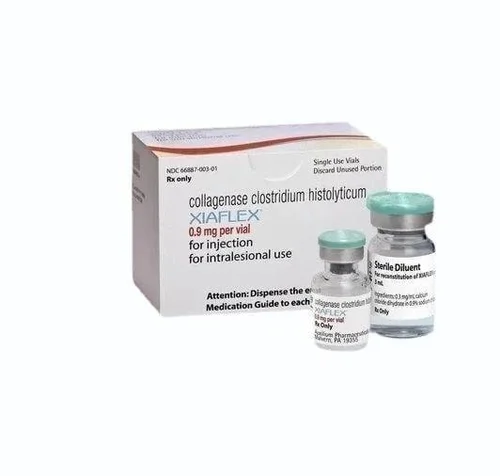
Xiaflex

Syringes 0.9mg dose

Clinic Room
💉 Xiaflex (CCH): The Collagen‑Targeting Workhorse
Xiaflex is the only commercially developed, Peyronie’s‑specific injection, built around collagenase clostridium histolyticum: a biologically targeted enzyme designed to interact with the dense Type I and Type III collagen that gives plaque its rigidity. This is the only FDA-approved medicine for Peyronie’s disease. It’s approved for use in adults with a moderate to severe curve and lumps under the skin that can be felt. Its role isn’t broad “treatment” but precise structural influence: softening the collagen architecture so the tissue becomes less resistant to mechanical forces. Because it’s a branded formulation, its preparation, dosing consistency, and delivery protocol are standardized, which is why it dominates real‑world usage compared to compounded agents. Clinicians typically discuss it once curvature stabilizes into a chronic anatomical phase and the plaque’s shape is predictable enough for targeted work. Xiaflex’s impact is localized, often accompanied by temporary swelling or bruising, but its biological specificity is what sets it apart; no other injection directly engages the collagen backbone of Peyronie’s plaque in this way.
🧪 Verapamil: The Fibroblast‑Focused Approach
Verapamil occupies a very different niche from Xiaflex because it isn’t a commercial Peyronie’s product, it’s prepared, usually by a clinic or compounding pharmacy, and used off‑label for its effects on the cellular environment surrounding the plaque. Instead of targeting collagen directly, Verapamil interacts with fibroblast behavior, extracellular matrix density, and the biochemical signals that help maintain plaque stiffness. This makes it a “micro‑environment modulator” rather than a collagen‑breaking agent. Its usage patterns vary widely between clinics because preparation methods aren’t standardized, and its effects tend to be more gradual and subtle compared to enzymatic collagenase. Still, Verapamil remains part of the historical and contemporary conversation because it represents a biologically plausible strategy: influencing the cells and matrix that give Peyronie’s plaque its long‑term rigidity.
🧬 Interferon‑α2b: The Inflammation‑Modulating Pathway
Interferon‑α2b sits in its own category because it doesn’t target collagen or the extracellular matrix directly. Rather, it focuses on the inflammatory and cellular signaling environment that helps maintain plaque rigidity. Used in generic, non‑branded form, it’s repurposed off‑label from its broader immunologic applications and applied here for its ability to slow fibroblast proliferation, reduce inflammatory reinforcement, and influence the biochemical cues that make plaque tissue persist over time. Its effects tend to be more systemic than other agents, which is why some individuals report flu‑like sensations after injections, and why tolerance varies more widely. Interferon‑α2b remains part of the Peyronie’s conversation because it represents a biologically distinct strategy: instead of breaking collagen or softening matrix density, it aims to dial down the cellular activity that keeps plaque architecture “alive,” making it a signaling‑focused counterpart to Xiaflex and Verapamil.
Injection Agents (Global, 2000–2025)
Trend lines incorporate the 2020 discontinuation of Xiaflex in Canada and Europe, based on provider-level data from the Oxford-published survey “Canadian Provider Perspectives on CCH for Peyronie’s Disease” (The Journal of Sexual Medicine, 2021).
Most clinicians shifted to surgery; fallback increases in Verapamil and Interferon remained limited.
Note on 2020 Trend Shift: In 2020, Xiaflex (CCH) was discontinued in both Canada and Europe due to manufacturer‑level commercial decisions. This withdrawal caused a measurable global inflection point: Xiaflex usage plateaued outside the U.S., while Verapamil and Interferon‑α2b saw modest temporary increases as clinicians reverted to off‑label alternatives. These changes are reflected in the 2020 segment of the graph, based on provider‑level data published in The Journal of Sexual Medicine (Canadian Provider Perspectives on CCH, 2021).
📑 Canadian Provider Perspectives on CCH
One of the clearest windows into real‑world injection trends comes from a national survey published in The Journal of Sexual Medicine in 2021 titled Canadian Provider Perspectives on Collagenase Clostridium Histolyticum for the Treatment of Peyronie’s Disease and the Impact of its Discontinuation. This study captured how clinicians actually use injection‑based therapies in practice, and it provides rare comparative insight into Xiaflex, Verapamil, and Interferon‑α2b. The findings were decisive: CCH (Xiaflex) was overwhelmingly preferred, with 93% of clinicians rating it superior to other intralesional options and 82% reporting they had administered it more than ten times. In contrast, when CCH became unavailable in Canada, only 36% planned to offer Verapamil and just 7% planned to offer Interferon‑α2b, underscoring how sharply usage drops when clinicians must rely on non‑branded, off‑label alternatives. This survey is one of the strongest pieces of published evidence demonstrating the modern shift toward collagen‑targeting injections and the corresponding decline of fibroblast‑modulating and inflammation‑focused agents. It anchors the broader trend seen across North America: as soon as a standardized, Peyronie’s‑specific formulation became available, clinical practice rapidly consolidated around it.
❌ Why CCH Was Discontinued in Canada & Europe
CCH’s withdrawal from Canada and Europe wasn’t driven by safety concerns or clinical failure; it was a commercial and regulatory decision. In both regions, the manufacturer (Endo Pharmaceuticals) chose to discontinue distribution after reassessing market size, reimbursement complexity, and the cost of maintaining regulatory approvals. Peyronie’s disease is a relatively small therapeutic market, and sustaining a biologic product across multiple regulatory jurisdictions requires ongoing investment in compliance, pharmacovigilance, and supply chain infrastructure. When Endo restructured its international portfolio, CCH was one of several products removed from non‑U.S. markets.
The result was abrupt: clinicians who had strongly adopted CCH were forced back to off‑label alternatives, despite overwhelmingly preferring collagenase. Importantly, no regulatory body banned or restricted CCH. The discontinuation was a manufacturer‑driven market exit, not a clinical or safety‑driven removal. This context explains why usage patterns in Canada and Europe shifted so dramatically and why the Canadian Provider Perspectives survey shows such a stark drop‑off in planned Verapamil and Interferon use once CCH disappeared.
🛠️ Breaking the Curve: Modeling and Home Care
Administering collagenase clostridium histolyticum (CCH) is rarely a passive pharmacological event. Because Xiaflex is designed to enzymatically disrupt the dense collagen matrix of the Peyronie’s plaque, biochemical softening alone is typically insufficient to straighten the penile shaft. Instead, modern clinical protocols couple the injection with active mechanical forces: a sequence of in-office modeling, patient-administered home stretching, and strategic abstinence windows designed to physically remodel the weakened tissue.
The In-Office Procedure and Modeling Phase
A standard CCH treatment course is usually structured around multi-injection cycles. Each cycle typically involves two injections administered a few days apart, followed by a mandatory clinical follow-up visit for penile modeling. During this in-office procedure, once the enzyme has had time to weaken the targeted collagen structures, the clinician applies controlled manual pressure to the erect or semi-rigid penis to stretch and rupture the remaining plaque fibers, effectively reducing the angle of curvature. This modeling phase requires clinical precision: too little force leaves the curvature uncorrected, while excessive force introduces risks to surrounding corporal structures. Treatment follows a common protocol overseen by a trained health professional.
Home Care: Stretching and Straightening Exercises
To complement the in-office procedures, protocols often integrate structured home-care regimens. Patients are generally instructed to perform gentle, daily penile-stretching and straightening exercises during specific windows of the treatment cycle. These home exercises are intended to maintain the mechanical tension necessary to elongate the tissue while the plaque heals in a more linear configuration. Rather than acting as a standalone cure, home stretching functions as an extension of the enzymatic process, ensuring continuous mechanical feedback during the cellular remodeling phase.
Post-Procedural Guidelines and Abstinence Windows
Because CCH induces localized trauma, acute swelling, ecchymosis (bruising), and micro-tearing within the tunica albuginea, strict post-procedural guidelines are embedded into treatment protocols. Clinicians mandate specific periods of sexual abstinence, typically lasting several weeks following an injection cycle, to allow the tissue to heal safely without interference from mechanical stress during intercourse. These safeguarding windows help minimize severe adverse events, such as corporal rupture or hematoma formation, ensuring that the structural integrity of the erectile bodies is preserved while the biological matrix reorganizes.
In clinical trials for Xiaflex (the primary FDA-approved injection for Peyronie’s), over 80% of patients experience noticeable penile swelling and bruising, and the vast majority report local pain or tenderness at the injection site. Because the enzyme is literally designed to break down dense tissue, localized bleeding under the skin (hematomas), dark purple bruising, and swelling are expected physical reactions rather than rare exceptions.
💳 Financial Breakdown: Costs & Coverage Nuances
While the figures in the table below serve as typical estimates based on current U.S. clinical pricing and insurance benchmarks, out-of-pocket expenses vary significantly depending on individual insurance policies, regional hospital margins, and local physician fees.
- Injectable Therapy (Xiaflex): Branded medication costs can easily reach $6,000 to $7,500+ per vial, leading to gross costs of upwards of $24,000 to $30,000+ for a full multi-cycle protocol before procedure or facility fees. However, for commercially insured patients, manufacturer Copay Assistance Programs can reduce the out-of-pocket medication cost down to $0 per dose. For Medicare beneficiaries, federal anti-kickback laws prohibit manufacturer copay support, leaving patients responsible for the standard 20% Part B coinsurance unless offset by a Medigap policy.
- Surgical Options (Plication & Implants): Surgical interventions range from around $10,000 for simple plication procedures to well over $30,000 for complex penile prosthesis implantation. Surgery is generally covered when deemed medically necessary, leaving patients to cover their plan’s specific deductibles, copays, or maximum out-of-pocket caps.
- Mechanical Therapy (Traction Devices): Specialized traction devices (such as RestoreX) typically cost between $500 and $1,000 as a one-time cash purchase. Insurance plans rarely cover these at-home mechanical medical supplies, meaning most patients pay out-of-pocket, though funds from Health Savings Accounts (HSA) or Flexible Spending Accounts (FSA) can usually be applied.


🧠 The Emotional Architecture of Peyronie’s Injections
Peyronie’s injection therapy along with other treatment options, take a heavy emotional toll on a patient. It starts with real fear and anxiety about needles in such a sensitive area, followed by the expected physical pain, severe bruising, and swelling after each in-office treatment. Beyond the clinic, physical curvature and anatomical changes drastically disrupt sex life: forcing painful periods of complete abstinence that build friction, distance, and frustration between partners. Combined with the shame of sexual dysfunction, the mind is pushed to its limit. Once treatments begin, the hardest part is the long waiting game: hoping for results, fearing it won’t work, and trying to stay patient through a slow, uncertain recovery.
🩲 Post-Procedure Comfort for Hypersensitive Skin
Beyond the internal tissue response, in-office Peyronie’s injections often leave the penile shaft and glans noticeably swollen, bruised, and tender to the touch. During these recovery windows, standard underwear creates an unexpected hurdle: rough fabrics, coarse seams, and constant movement-induced friction can scrape against the hypersensitive, recovering skin, making everyday walking or sitting uncomfortable.
Our specialized recovery briefs make a critical difference. Engineered specifically for penile post-procedure and penile treatment care, Our briefs feature a dedicated NonFriction™ interior pouch that surrounds and isolates sensitive skin from abrasive outer clothing. Rather than squeezing or rubbing against local swelling and hematomas, the cushioned, seamless interior creates an insulating barrier that prevents fabric contact, creates space, and keeps post-treatment recovery noticeably more manageable.
Support your Recovery with Catchfords → Men’s Briefs


